Why AI Agents Need Workflows to Deliver Real Business Value
There's a moment many business leaders recognize. You watch a demo of an AI agent. It answers questions fluently, drafts emails in seconds, summarizes reports instantly, and seems capable of doing the work of several people at once.
You think: Hm, this changes everything. A few months later, the excitement has faded. The agent is still there, but somehow it hasn't transformed the business. In many cases, it's mostly helping people rewrite emails or summarize meeting notes.
So what happened? The AI itself wasn't the problem, but the fact that AI had nowhere meaningful to go created quite a challenge.
A Brilliant Employee with No Role
One of the simplest ways to think about an AI agent is as a highly capable new employee. Imagine hiring someone exceptionally smart, giving them access to company information, and then telling them, "Just help wherever you can." There's no onboarding, no responsibilities, no process, no definition of success. Most likely, they'd stay busy all day. They'd answer questions, generate ideas, and volunteer for tasks.
But would they create measurable business value? Probably not. Because capability without structure usually creates activity rather than results. Many AI initiatives get stuck there: a company deploys powerful agents and expects value to emerge automatically. But an agent, no matter how intelligent, still needs a process within which to operate.
What Workflows Actually Do
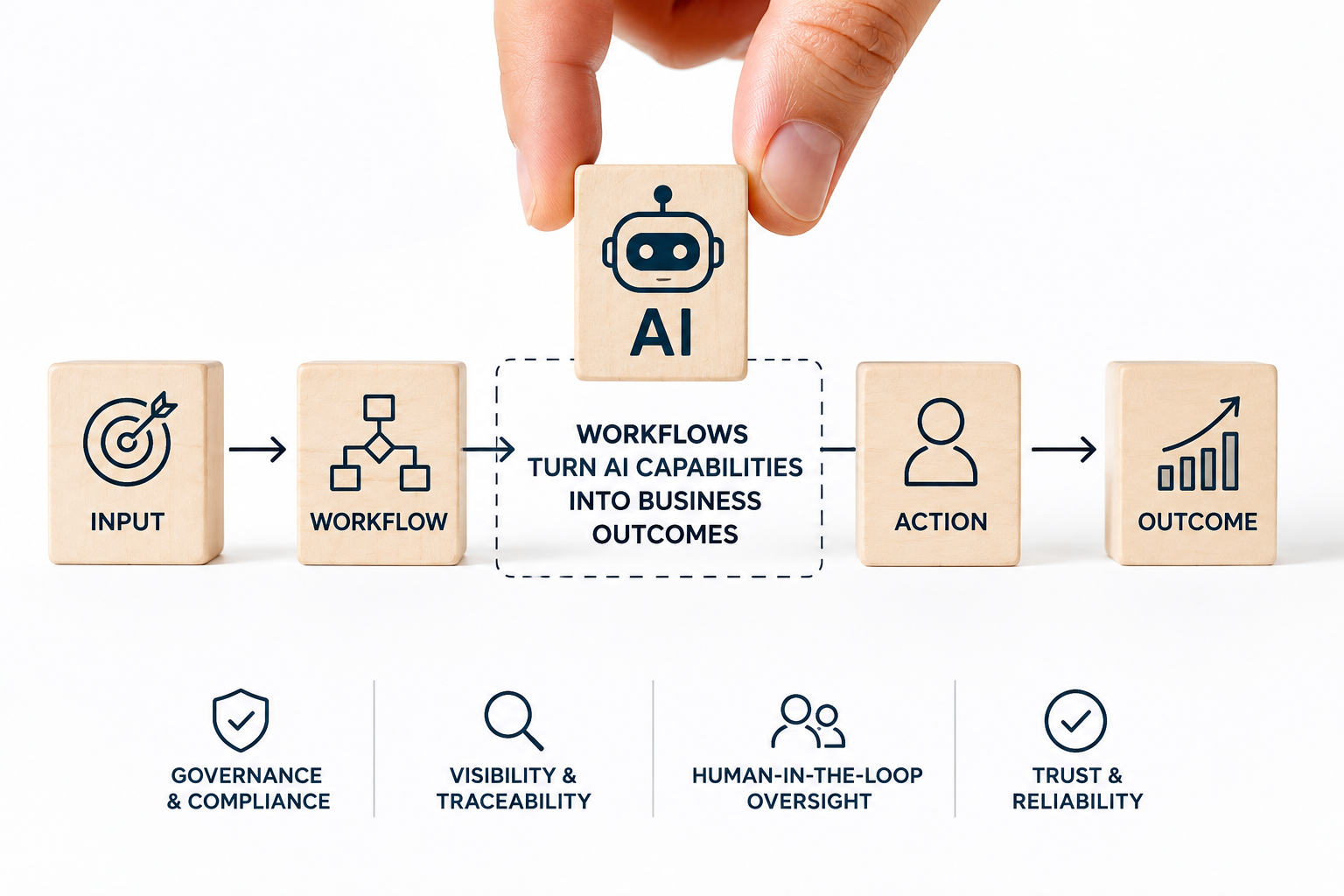
A workflow is what connects AI capabilities to business outcomes. It defines the sequence of actions, decision points, approvals, handoffs, and exceptions that turn individual tasks into a complete business process. In simple terms, workflows answer the questions an AI agent cannot answer on its own: what happens next? Who should be involved? When should a human step in? What counts as success? How do we know the work is finished? Without those answers, even the most capable agent becomes little more than a sophisticated assistant.
A Customer Support Example
Take customer support. An organization deploys an AI agent to handle incoming customer inquiries. The agent performs well and successfully resolves a large percentage of requests. But then problems start appearing. The difficult cases remain unresolved. Some customers never receive follow-up responses. Certain conversations require human intervention but never reach the right people.
The issue is the missing process around the agent. Now, compare that with a company that designs the full workflow first: Customer inquiry → AI triage → resolution attempt → confidence check → human escalation when necessary → follow-up communication → ticket closure.
The technology is the same, and the results are completely different. The difference is the workflow.
The Same Pattern Appears Everywhere
This isn't limited to customer support. In financial services, AI agents can identify potentially suspicious transactions. But the value comes from the workflow that routes those alerts to the right analyst, provides the necessary context, and ensures timely review. Without that workflow, organizations often end up with hundreds of alerts and a team that gradually stops paying attention to them.
Healthcare provides another good example. AI can dramatically accelerate patient intake by pre-filling forms and gathering information before appointments. But if there is no process for validation, conflict checking, and exception handling, the organization gains speed while introducing new risks.
In both cases, the AI is doing its job. The workflow is what turns that activity into business value.
"We thought the AI would do the heavy lifting. And it could
but only after we stopped treating it as a standalone tool
and started treating it as part of a larger process. That's when
we moved from an experiment to something that actually scaled."
— Operations Director, mid-size logistics company
Why Workflows Build Trust
There's another benefit that receives far less attention: trust. For most organizations, trust is the real barrier to AI adoption.
Teams need confidence that the system is behaving as expected. Managers need visibility. Compliance teams need oversight. Leadership needs accountability. A well-designed workflow provides all of that.
When an AI agent operates inside a defined process, every action becomes visible and traceable. You can see what happened, why it happened, and what happened next. That transparency allows organizations to gradually increase automation with confidence. Without workflows, AI often feels like a black box, and businesses don't scale black boxes.
"Our compliance team would never have approved AI
interacting with client data without a documented process around it.
The workflow wasn't just an operational requirement—it was the foundation of trust."
— Head of Digital Transformation, European insurance group
Start with the Process
One of the biggest misconceptions in the AI market today is that success starts with selecting the right agent. In reality, successful organizations often start somewhere else entirely. They begin by asking: What process are we trying to improve? Once that process is understood, they identify bottlenecks, repetitive decisions, and areas where AI can contribute most effectively. Only then do they define the role of the agent.
This approach may sound less exciting than deploying the latest AI technology. But it is consistently what separates successful implementations from disappointing pilots.
The Companies Seeing Results Understand This
AI agents are among the most powerful business tools available today. But like any powerful tool, they need direction.
The organizations generating meaningful returns from AI aren't necessarily the ones using the most advanced models. More often, they're the ones that have taken the time to design clear workflows around them. The technology is ready. The question is whether the process is ready, too, because AI agents may be the engines but workflows are still the roads.